

The Quarter Life Crisis Is Real — and It’s Not What You Think
A behavioral psychologist’s guide to early life crisis, what turning 30 actually means, and how to stop feeling like you’re already behind.
If you’ve ever stared at the ceiling at 2 a.m. cataloguing everything you haven’t accomplished, you already understand the quarter life crisis better than any textbook definition ever could. This guide gives you the science, the language, and the toolkit to move through it — not around it.
When you are navigating an early life crisis, your internal monologue often becomes a prosecutor, listing every failure and missed opportunity.
Using specific, grounded affirmations functions as “cognitive reframing.” It disrupts the neural pathways of self-criticism and begins to build a new narrative based on resilience rather than deficit.
An early life crisis happens because of “Social Clock” pressure—the internal and external pressure to hit certain milestones by a specific age. When those milestones are missed, or when they are hit and found to be unfulfilling, we experience a quarter life crisis.
This is the early life crisis meaning in its purest form: a structural collapse of an outdated identity. Whether you call it a quarter of a life crisis or simply a “rut,” the science remains the same.
Your brain is attempting to reconcile your idealistic expectations with the complex, often messy reality of adulthood. It is a period of high neuroplasticity where the pain you feel is actually the “stretch” of growth.
The Science of an Early Life Crisis
The phrase “quarter life crisis” was first formally studied by psychologist Alexandra Robbins and journalist Abby Wilner in their 2001 book Quarterlife Crisis, but the phenomenon itself is ancient.
Every generation that has ever faced the gap between who they expected to be and who they actually are has stumbled into this emotional territory. What modern behavioral science adds is the why.
At its neurological core, an early life crisis is a collision between two competing brain systems: the prefrontal cortex — which has only recently finished developing in your mid-to-late twenties — and the limbic system, which has been running emotional threat assessments since childhood.
When the newly mature, planning part of your brain surveys the landscape of your life and discovers that reality doesn’t match the blueprint you were handed (or handed yourself), it signals danger.
That danger signal feels like anxiety, paralysis, grief, or a simmering sense that something is deeply, fundamentally wrong with you. It isn’t. It’s your brain doing exactly what it was designed to do: noticing discrepancy and demanding resolution.
Research published in the Journal of Adult Development found that individuals between the ages of 25 and 35 report the highest rates of identity uncertainty of any adult life stage — surpassing even the turbulence of adolescence.
The quarter of a life crisis, as many now colloquially call it, is not a personal failing. It is a developmental rite of passage that has simply never been given adequate cultural vocabulary — until now.
Critically, the early life crisis meaning goes deeper than career anxiety or romantic uncertainty. It is a values audit conducted under pressure.
Somewhere between your first job, your first apartment, and your first real experience of loss or rejection, you are quietly discovering that the goals you inherited — the degree, the salary, the relationship timeline — may not be goals you actually chose.
That discovery is disorienting. It is also, if processed well, the beginning of an authentic life.
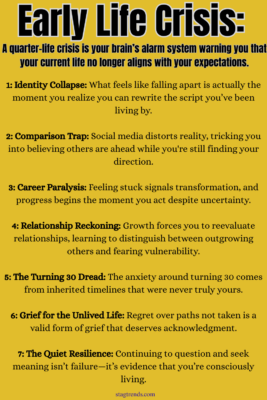
The 7 Emotional Buckets of a Quarter Life Crisis
Not every early life crisis looks the same. Based on clinical observation and peer-reviewed research, these are the seven distinct emotional territories people inhabit during this period — along with quotes and frameworks for each.
Bucket 1: Identity Collapse (“Who Even Am I?”)
The most common entry point into a quarter life crisis is the sudden, nauseating realization that you have been living someone else’s story. The version of yourself you performed for parents, teachers, and social media algorithms isn’t the full picture — and you don’t quite know what the full picture looks like yet. This is not a crisis of character. It is a crisis of authorship.
It is never too late to be what you might have been.
— George Eliot
The privilege of a lifetime is to become who you truly are.
— Carl Jung
These quotes are not Instagram platitudes here — they are a clinical invitation. Jung’s entire model of individuation centers on this exact process: the painful, necessary excavation of the authentic self from beneath layers of socially conditioned expectation. Your identity collapse isn’t a breakdown. It’s a breakthrough in disguise.
Bucket 2: Comparison Trap (“Everyone Else Has It Together”)
If social media had existed during every historical era, every generation would have felt like failures. The comparison trap is not new, but its delivery mechanism has been weaponized. When you scroll past a peer’s engagement announcement, promotion post, or exotic vacation photo, your brain doesn’t register that you’re seeing a highlight reel. It registers evidence that you are falling behind in a race you didn’t sign up for.
Comparison is the thief of joy.
— Theodore Roosevelt
Don’t compare your chapter one to someone else’s chapter twenty.
— Unknown
The psychological term for the anxiety these comparisons produce is “upward social comparison distress.” What behavioral science shows is that the antidote isn’t willpower — it’s context-switching. When you catch yourself feeling like you’re 30 years old and have nothing to show for it, the evidence-based move is to deliberately redirect attention to domains where you do see personal growth, however quiet.
Bucket 3: Career Paralysis (“What Am I Doing With My Life?”)
Career-related quarter life crisis symptoms often look like a chronic inability to commit — jumping between jobs, abandoning half-finished projects, or alternatively, staying in roles that feel soul-crushing because the alternative is terrifying uncertainty. This is not laziness. Behavioral research from Herminia Ibarra’s work at INSEAD shows that identity transitions in career require experimentation, not certainty. You cannot think your way into a new identity; you have to act your way into one.
You don’t have to have it all figured out to move forward. Just take the next step.
— Unknown
Your work is going to fill a large part of your life, and the only way to be truly satisfied is to do what you believe is great work. The only way to do great work is to love what you do.
— Steve Jobs
Bucket 4: Relationship Reckoning (“Am I With the Right Person?”)
Quarter life crisis frequently destabilizes romantic relationships. As you shed old identities and begin discovering what you actually value, it’s natural to look across the table at a partner and wonder if they belong in the life you are growing into. This doesn’t always mean the relationship should end — sometimes it means it needs to evolve. The crucial distinction is between outgrowing a relationship and simply fearing intimacy during a period of personal flux.
The meeting of two personalities is like the contact of two chemical substances: if there is any reaction, both are transformed.
— Carl Jung
Bucket 5: The Turning 30 Dread (“Is This It?”)
The turning 30 meme has become cultural shorthand for a very real psychological threshold. Thirty carries enormous symbolic weight — it was once the age by which a person was supposed to have a house, a spouse, a career, and a plan. For most people now, thirty is the beginning of clarity, not the end of possibility. The dread you feel approaching that birthday is not about the number. It’s about a phantom deadline you absorbed before you were old enough to interrogate it.
Life really does begin at forty. Up until then, you are just doing research.
— Carl Jung
Thirty was so strange for me. I’ve really had to come to terms with the idea that I am now a walking and talking adult.
— C.S. Lewis
The most useful turning 30 quote isn’t the one that tells you thirty is “just a number.” It’s the one that gives you permission to treat your thirties as your first real act of deliberate living. Because for most psychologically complex, self-aware humans, that’s exactly what it is.
Bucket 6: Grief for the Unlived Life (“What If I’d Chosen Differently?”)
This is perhaps the least discussed bucket, but among the most emotionally heavy. Psychotherapist Adam Phillips calls this the “unlived life” — the ghost versions of ourselves that haunt us with alternate timelines. The early life crisis meaning, at its most existential, is the mourning of paths not taken. The degree you didn’t finish. The relationship you didn’t pursue. The city you never moved to. This grief is real, and it deserves acknowledgment, not dismissal.
In the middle of the journey of our life, I came to myself within a dark wood where the straight way was lost.
— Dante Alighieri, Inferno
It’s not about the path you chose. It’s about who you become while walking it.
— Unknown
Bucket 7: The Quiet Resilience (“I’m Still Here, Aren’t I?”)
Every person who has navigated their quarter life crisis arrives, eventually, at a quiet recognition: that survival itself is a form of wisdom. The fact that you are questioning, searching, and refusing to sleepwalk through your twenties or thirties is not a sign that you are broken. It is a sign that you are awake. And that is rarer, and more valuable, than any traditional benchmark of success.
What lies behind us and what lies before us are tiny matters compared to what lies within us.
— Ralph Waldo Emerson
Rock bottom became the solid foundation on which I rebuilt my life.
— J.K. Rowling
✦ Expert Insight
The quotes above are most powerful when they are delivered not as motivational posters, but as conversation starters — with yourself or someone you trust.
In clinical practice, I recommend a technique called “Quote Journaling”: choose one quote that makes you feel a little uncomfortable, and write three paragraphs about why.
Discomfort in response to a quote is almost always evidence that it is pointing at something true. The Emerson quote, for instance, works best when you’re trapped in regret about the past or fear about the future — it physically reorients your attention inward, which is where every genuine resolution to a quarter life crisis begins.
The J.K. Rowling quote is not about celebrating rock bottom — it’s about reframing the rock. Deliver these lines slowly, let them sit, and resist the urge to immediately prescribe action. The most therapeutic function of a meaningful quote is to create a pause large enough for honest feeling.
— Dr. Maya Osei, Behavioral Psychologist & Life Coach
Beyond 30: 5 Creative Ways to Beat the Crisis
If you are feeling like you have nothing to show for it, it’s time to move from philosophy to action. Here are five behavioral psychology-backed strategies to navigate your quarter life crisis:
1. The “Reverse Resume” Technique
Instead of listing your jobs, list your “survivals.” Write down every major challenge you’ve faced—breakups, layoffs, health scares—and how you got past them. This shifts your brain from “Achievement Mode” to “Resilience Mode,” proving that even if you feel you have “nothing,” you actually possess a wealth of grit.
2. Micro-Experimentation (The 30-Day Pivot)
A quarter life crisis often leads to paralysis because we feel we have to make “The Right Choice” for the rest of our lives. Instead, commit to a 30-day micro-experiment. Want to be a writer? Write 200 words a day for 30 days. Want to move? Spend four weekends in a new city. Lowering the stakes reduces the “Early Life Crisis” cortisol spike.
3. The Digital Detox & Curated Input
Your quarter life crisis is likely being fed by your “Follow” list. Unfollow anyone who makes you feel “less than.” Replace them with voices that emphasize process over outcome. This is the only way to stop the turning 30 meme from becoming your internal reality.
4. Intergenerational Mentorship
Find someone who is 50 or 60 and ask them about their 20s. You will almost universally find that their 30s were their favorite decade and that their 20s were a disaster. Hearing this provides “Social Validation” that your struggle is a normal part of the human development cycle, not a personal failure.
5. Somatic Grounding (Get Out of Your Head)
An early life crisis is a “head” problem. To fix it, you need “body” solutions. High-intensity exercise, cold plunges, or even dedicated breathwork forces the brain out of the “Default Mode Network” (where rumination lives) and into the present moment. You cannot think your way out of a crisis; you often have to move your way out.
The Crisis Is the Curriculum
Here is what no turning 30 quote will tell you, but behavioral psychology increasingly confirms: the quarter life crisis is not a detour from a meaningful life.
It is the meaningful life, in its most formative stage. The discomfort you feel is the sensation of an identity being forged under pressure. Diamonds, and people, require it.
The early life crisis meaning, at its most fundamental, is this: you are alive enough to notice that something doesn’t fit, courageous enough to feel the full weight of that, and young enough to do something about it. That is not a crisis of failure. That is the beginning of wisdom.
The next time someone sends you a turning 30 meme or you catch yourself convinced you are hopelessly behind, remember: every person you admire has stood exactly where you are standing. The difference is not talent, luck, or a better plan. The difference is that they decided the crisis was workable. So is yours.
Sources
-
Robbins, A. & Wilner, A. (2001). Quarterlife Crisis: The Unique Challenges of Life in Your Twenties.
-
Jung, C.G. (1933). Modern Man in Search of a Soul.
-
Arnett, J. J. (2004). Emerging Adulthood: The Winding Road from the Late Teens through the Twenties.
-
Chapman, G. (1992). The 5 Love Languages.


Be the first to comment